
North American Crop Update
- Monday May 28, 2009
This analysis featured in the May 22, 2009 issue of the HGCA's MI Prospects, Volume 11, Issue 23
Spring sowing has been delayed in both the US and Canada and the next few weeks will prove more critical than usual in terms of harvest outcomes. US winter wheat production in 2009 is estimated to be 20% lower than in 2008.
Winter wheat production was placed at 40.9Mt in the USDA's first survey-based estimate, 20% below last year's harvest. This was based on conditions as at May 1. The harvested area is forecast 14% down after a larger allowance for abandonment while yield is seen 6% lower. Conditions for the Hard Red Winter (HRW) and the Soft Red Winter (SRW) wheat crops are very different. For the SRW wheat crop the same wet conditions that are delaying spring sowing of maize and soyabeans have so far created close to ideal conditions. For HRW very dry conditions in parts of Texas and Oklahoma are reducing yield and raising abandonment expectations.
However, since the May 1 when this survey was undertaken, conditions for the winter wheat crop have improved somewhat (Graph 1). Based on current conditions, it may therefore be reasonable to expect estimates for the winter wheat crop to increase.
continue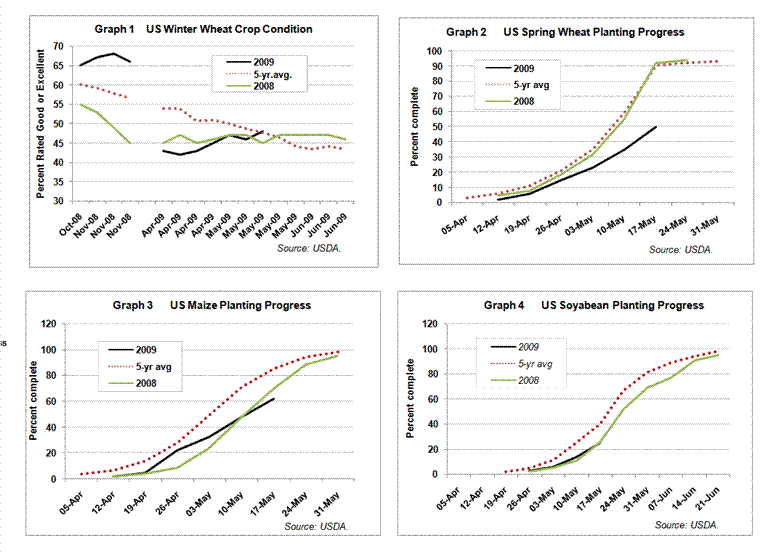
Spring wheat areas in the USDA prospective planting survey were 1.0Mha of durum and 5.4Mha of other spring wheats, 10 and 6% less than in 2008, but slightly above the previous five-year average. The delays in planting following an abnormally wet and cold spring may, however, result in a small area. As of May 17 planting was 50% complete, which was about 10 days behind average (Graph 2). The weather forecast at that time was favourable for planting and farmers are reputed to have increased planting capacity significantly in recent years. With good soil moisture and without obvious late season crop alternatives, farmers are likely to risk planting a crop rather than opt for summer fallow. But late sown wheat crops will be more at risk to adverse crop conditions during the summer than usual this year.
In its May 12 supply and demand projections the USDA used a wheat yield of 2.78t/ha on an area of 19.8Mha, thereby using its 2009 winter wheat estimate and prospective planting area and trend yields for spring wheats. The resulting projection of a 55.1Mt US wheat crop in 2009 may therefore be a little optimistic for spring wheat and pessimistic for winter wheat, but on balance still a reasonable expectation. Given this production scenario, the USDA projects wheat exports of 24.5Mt next year which would be lowest since 2002/03.
Maize planting has also been delayed by wet field conditions, as indeed it was last year. As of May 17, sowings were 62% complete and about 10 days behind the five-year average of 85% and four or five days behind last year's 70% (Graph 3). Late planting last year was compounded by very wet conditions for crop emergence, but seemingly little switching to late season soyabeans occurred.
The challenge this year is that planting is more delayed in some states than others, with states adjacent to the Great Lake states worst affected. Some switching of area from maize to soyabeans in these areas seems inevitable. But since much of the crop has been planted on time, yields are probably not as compromised as they were last year.
The USDA's 2009/10 supply and demand projections use a production estimate of 307.1Mt, derived from a trend yield of 9.75t/ha on 31.5Mha - the prospective planting area allowance for usual forage area and abandonment. This may seem a little optimistic at this stage of the season. Hence, the export projection of 48.3Mt may be a little optimistic from a supply perspective as the USDA is also projecting a decline in ending stocks.
Soyabean planting is progressing well where wet conditions have not held up maize planting. In areas where maize planting is behind, next to no soyabeans have been planted. As of May 17, 25% of the crop had been planted on a par with last year but about a week behind the five-year average of 40%, (Graph 4). Soyabean sowings into June is not usual and, from past experience and on balance, any area switch to soyabeans will result in increased production.
The USDA's May 12 supply and demand projection used a production estimate of 87.0Mt, with a yield of 2.86t/ha on a harvested area of 30.4Mha. As with maize this was derived from a trend yield and the Prospective Planting area after allowance for past abandonment. Depending on field conditions in the corn belt over the next few weeks, this may prove to be a conservative estimate, particularly as new crop soyabean prices have risen by almost 25% since the Prospective Planting survey. This reflects expectations that soyabean markets are likely to remain tight until the 2010 South American harvests.
In Western Canada, spring sowings are proceeding more slowly than usual due to the cool conditions. The Canadian Wheat Board reported temperatures of normal to a few degrees below normal across the Prairies during the week ending May 13. This follows a colder than usual winter and start to spring. At that time sowing was assessed as 20% complete, compared to 28% reported on May 15 last year and 36% for the five-year average for that date.
Although air sowing has dramatically increased their sowing capacity, late planting has the potential to switch out of wheat into shorter season barley, canola or oats and even an increase in summer fallowing.
Dry conditions in west-central Saskatchewan and east-central Alberta are beginning to raise concerns. Moisture conditions to the east are more favourable. In the drier areas barley, oats or fallow are likely options. Where moisture is adequate, canola is likely to be favoured on tighter supply prospects and rising prices.
continue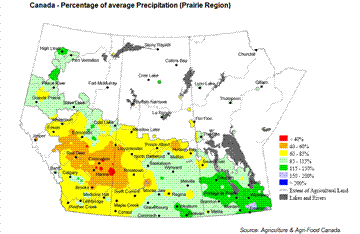
In Eastern Canada and particularly in the arable areas of Ontario which are virtually surrounded by the Great Lakes, maize sowing was reported to be about 60% completed as of May 14, compared to an 80% target, with soyabeans about 5% completed. So Ontario looks somewhat better than south of the border.
David Walker (001) 780 434 7615
top of page